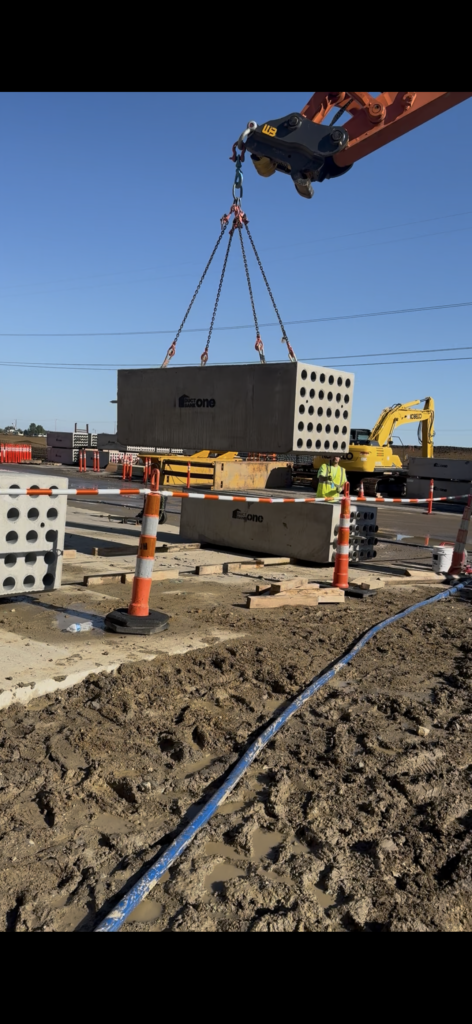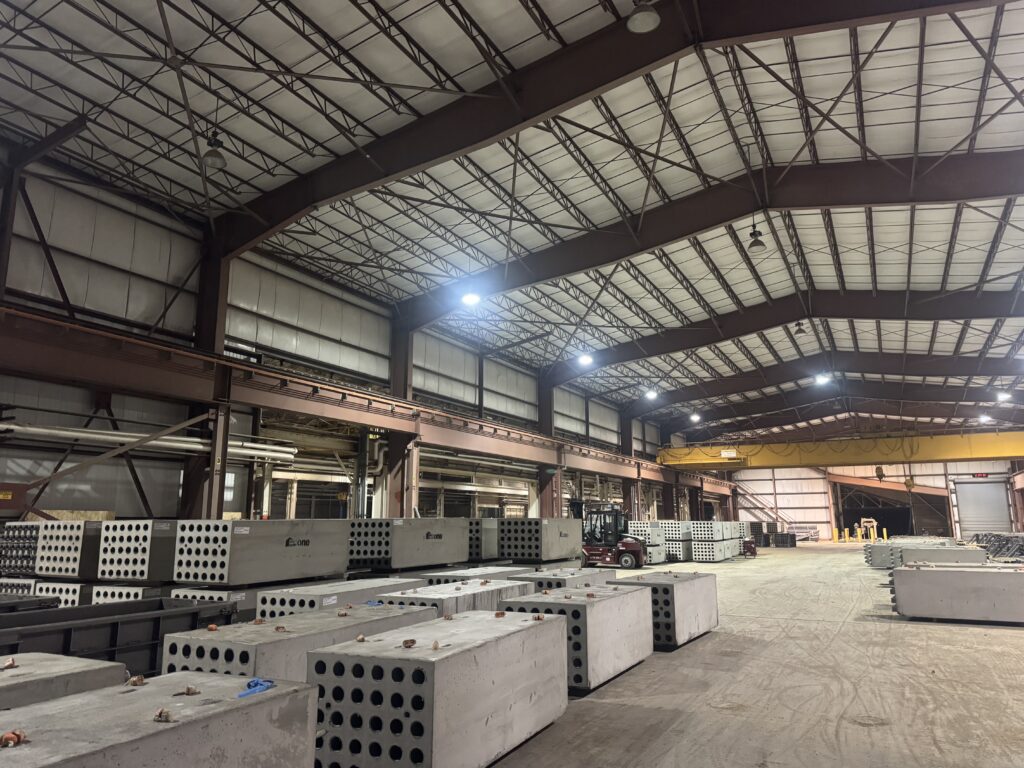

A precast duct bank is a factory-built concrete assembly with conduits (raceways) already embedded in precise alignment. Instead of building a duct bank in a trench with loose pipe, rebar, forms, and a field pour, crews set modular sections by crane, connect them, and backfill. The result is a protected, code-compliant pathway for critical cabling.
What It’s Made Of
- Conduits: Typically PVC Schedule 40/80 for medium-voltage power and communications.
- Concrete encasement: High-strength, plant-controlled mix designs engineered for Traffic / HL-93, E80 (railcar loading), aircraft loading and pedestrian loads with optimized thermal performance for cable ampacity.
- Reinforcement & hardware: Rebar or fiber reinforcement, lifting anchors, alignment pins/shear keys, and gasket joints or slip joints depending on project requirements.
What It’s For
- Power distribution: Medium-voltage feeders between switchgear, transformers, generators, substations.
- Telecom & controls: Fiber/copper backbones, SCADA, and low-voltage control systems.
- Where it’s used: Data center campuses, industrial facilities, substations, airports, ports, and large institutional sites.
Precast vs. Cast-in-Place (CIP): What Buyers Should Know
| Dimension | Precast Duct Bank (DBO) | Cast-in-Place (CIP) |
| Safety | Minimal time in open trenches; fewer worker-hours at depth; reduced shoring exposure. | Prolonged trench occupancy; manual formwork, rebar, and pour hazards. |
| Schedule | Sections set in minutes; fabrication runs parallel to sitework; weather delays minimized. | Sequential process: excavate → place conduit → tie rebar → form → inspect → pour → cure → remove forming. Easily delayed by weather. |
| Manpower | Small civil crew and operator; electricians focus on terminations and testing. | Larger crew required for conduit layout, tying, pouring, and finishing. |
| Quality | Plant QC, consistent conduit spacing due to premium mold design, engineered joints, tested loads/thermal performance. | Variable alignment, cover, and consolidation depending on field crew and conditions. |
| Risk | Predictable installation rates and quality; less rework. No change orders for weather delays. | Higher variability; risk of misalignment, overpour or concrete defects. |
| Operations | Shorter closures and faster road/yard restoration. | Longer disruptions for curing and inspection. |
Why Precast Is Becoming Standard in Industrial and Hyperscale Construction
- Speed at Scale: Data centers and industrial projects operate on compressed schedules. Precast duct banks shift production offsite—sections arrive ready to install, allowing trench work and fabrication to happen simultaneously.
- Safety by Design: The fastest way to reduce trench-related incidents is to spend less time in the trench. DBO’s precast approach minimizes confined-space exposure, formwork, and manual material handling.
- Labor Efficiency: Skilled electrical labor is limited. Precast moves repetitive conduit and encasement work into a controlled environment, freeing electricians for higher-value scopes and allowing smaller, faster site crews.
- Predictable Quality: Factory fixtures and laser-cut forms ensure precise conduit spacing, cover, and alignment. Each module is engineered for load, thermal, and performance—every piece identical and verifiable.
- Thermal and Structural Performance: DBO’s concrete mix designs are optimized for low thermal resistivity (ρ) and HL-93/HS-20, E80, aircraft load ratings, ensuring cable efficiency and long-term durability under heavy traffic or crane loads.
- Environmental and Logistical Advantages: Precast duct banks reduce spoil, shrink trench widths, and minimize overpour waste. Controlled casting enables use of low-carbon cement blends, lowering embodied carbon for owners tracking sustainability metrics.
How DBO’s Solution Stands Apart
DBO stands apart for one reason: capacity. We produce 10× more than other precast suppliers and install it faster and safer.
- Capacity that eliminates supply risk: With up to 3,200 ft/day of throughput and week-one submittals, GCs can lock in duct bank availability months before install—and avoid the 3–10 month backlogs common with competitors.
- Install speeds that cut critical-path durations by 4–8×: Typical cast-in-place yields 50–100 ft/day with double-digit trench crews. DBO installs routinely hit 400–600 ft/day using a single operator and one laborer.
- Patented safety built into the joint: 18” guide pins keep hands clear, prevent misalignment, and remove the need for large crews down in the trench—reducing safety exposure by 80%+.
- Precision that reduces rework and future expansion pain: Tight tolerances and zero over-pours let GCs and owners add conduit later without saw-cutting through unknown concrete masses—a common six-figure problem on cast-in-place jobs.
- Designed for fast-track campuses: Hyperscale sites run on fixed energization dates and rolling design changes. DBO’s capacity + modularity lets you adapt in real time without losing the schedule.
When to Choose Precast
- Runs longer than 200–300 ft or repeating bank configurations (e.g., 4×4, 6×4).
- Road, rail, or yard crossings where downtime is costly.
- Tight sites needing smaller trenches and cleaner laydown.
- Hyperscale or industrial campuses operating on fast-track design-build schedules with no tolerance for delays.
Why the Industry Is Moving to Precast
Precast duct banks are redefining underground electrical construction. They deliver faster schedules, safer installations, and higher consistency than traditional cast-in-place methods. DBO turns a site-built risk item into a manufactured infrastructure product—engineered, repeatable, and ready to energize the modern power and data landscape.