
A bad supplier pick doesn’t show up at the purchase order. It shows up months later with 400 feet of trench open, an excavator idling on the clock, and a piece on the truck that won’t go where the drawing says.
Eight questions sort a duct bank manufacturer from a concrete vendor. A real answer to each one has a number attached. If you get an adjective, keep asking.
Quick Reference
Every number below is a DBO figure. Use them as the benchmark when you evaluate anyone — or pull them straight into a bid package.
| What to check | Number to ask for | DBO |
|---|---|---|
| Conduits per section | Count and stackability | Up to 30, stacked to a 120-way run |
| Deviation tolerance | Percent, elevation and horizontal | 0 to 8% |
| Thermal resistivity | RHO, oven-dry | Under 60, tuned below 55 on request |
| Load rating | Standard and margin above it | HL-93 + 25%; rail, crane mat, aircraft engineered |
| Install rate | LF per shift, and crew size | 300–320 LF, 5-person crew |
| Trench cycle | Dig to backfill | Same day |
| Drive-over | Time after backfill | ~30 minutes, no cure window |
| Joint alignment | Distance hands stay clear | Guide pins engage at 18 inches |
| Lead time | Weeks to first delivery | 4 to 6 |
| Stamped calcs | Days after design approval | 10 to 14 |
| Cure policy | Ships before full strength? | Never |
| Damage rate | Percent of pieces | Under 0.5% |
| Where it doesn’t fit | Honest limits | Runs under 500 ft, congested urban, live substations |
1. Does their system meet our design and utility requirements?
Duct banks used to run 8 or 10 conduits. AI campuses are specifying 106 and 120. Ask whether the supplier builds to your section, or whether you redraw your section to fit their form.
At DBO:
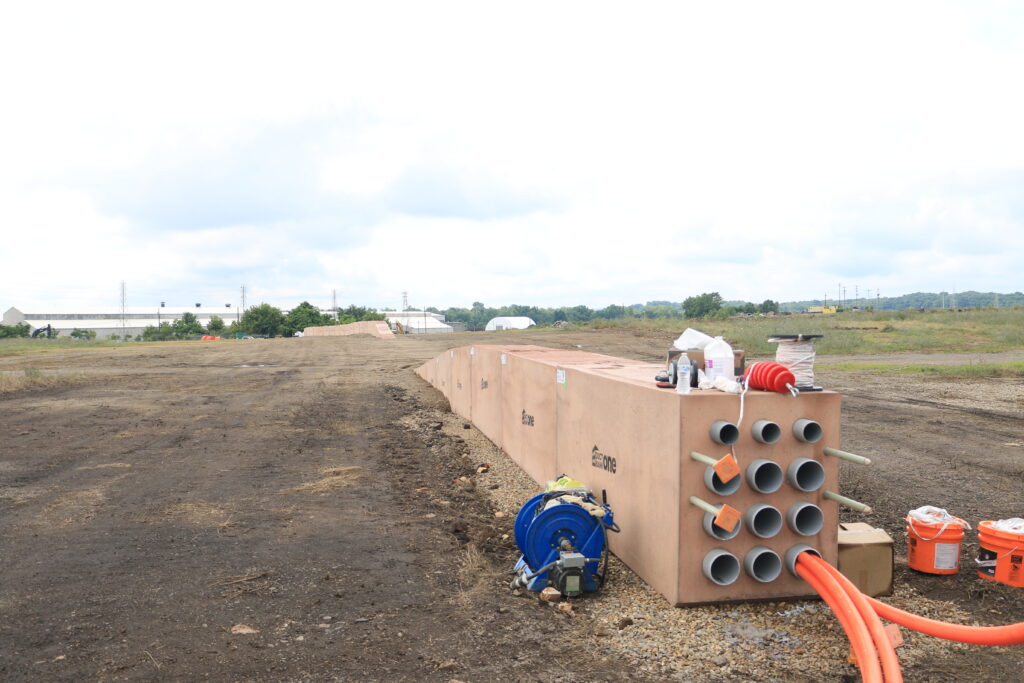
- Up to 30 conduits in one section, stacked side by side and on top to build a 120-way run.
- Every piece sized to the excavator already on your site. If it’s too heavy for your machine, we split it. You don’t rent a bigger one.
- HL-93 is the baseline, tested 25% above it. Rail, crane mat, and aircraft loads are engineered cases, not catalog options.
- Our mix runs under 60 RHO oven-dry, and we’ll tune it below 55 when the spec calls for it. We also extend the concrete above the conduits inside the precast, which takes flowable fill off your scope entirely on most MV runs. Ask any supplier for heat dissipation calcs at the submittal phase, not after — that’s while your electrical calcs still have room to move.
Ask: can you build to my section?
2. What is the true all-in cost?
Our material cost runs marginally higher than cast-in-place. That’s freight. We deliver finished, cured sections to your site instead of raw pipe and concrete to a staging area.
That’s also the only line most bid packages compare, and it’s the wrong comparison.
Duct bank scope usually gets priced in separate buckets: material in one, labor in another, excavation in a third. Bucket to bucket, precast looks more expensive, because material is the only bucket where it is.
Here’s what the other two buckets hide.
On cast-in-place, excavation and installation are two different scopes with two different crews. Three or four people dig. Then the machine sits while ten electricians work the trench for a week, with the equipment still on the rental clock.
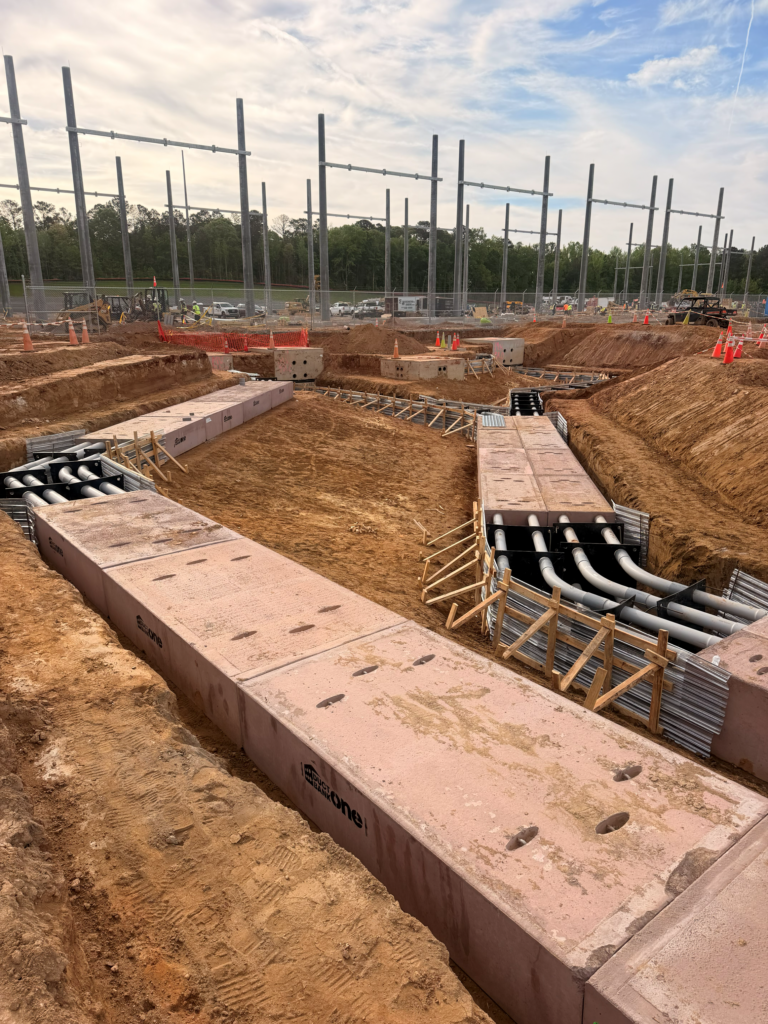
On precast, the excavation is the install. The same excavator that digs the trench and pulls the box drops its bucket and sets the sections. One crew, one machine, one line on the schedule.
Half the labor. A fraction of the excavation duration. That’s where the freight comes back, and the schedule is what you keep on top of it.
Two things move the number:
- Remote campuses swing hardest. Flown-in labor, per diem, man camps. Effective rates run three to five times a local hall. Cutting the crew in half against a 5x rate is a different number than cutting it in half in a metro market.
- Short runs don’t pencil. Under 500 feet, the crew never finds its rhythm. Four-way or less needs volume to work.
Price the scope, not the material. Compare material to material and precast loses every time. Pull labor and excavation into the same number and it isn’t close.
Send us the run and we’ll build the comparison against your own numbers.
3. Can they meet our project schedule?
Most precast plants run duct banks on the same lines as vaults, manholes, and barriers. When demand spikes, duct banks go to the back of the queue. That’s why 8-week quotes turn into 6 months.
DBO runs 320 sections a day on dedicated duct bank lines, with four curing lines cycling every eight hours. Stamped calcs come back in 10 to 14 days. Typical delivery is 4 to 6 weeks, cured and staged before your trench opens.
Ask: what’s your daily casting capacity, and is that line dedicated or shared? A supplier who can’t give you a number doesn’t have one. Get capacity confirmed and validated before materials are released, not after — schedule alignment is cheap to fix in preconstruction and expensive to fix once the trench is open.
4. How safe is the system to install?
Skip the safety statement. Ask where a worker’s hands are when a 10,000-pound section closes on the one in front of it.
On most systems, four inches. Someone stands in the joint lining up ten conduits by hand while the gap closes.
On ours, 18 inches. The dowel pins engage while the sections are still a foot and a half apart. The installer walks clear and the pins pull the joint into alignment. No hands, no pry bars.
The pins protect more than hands. They protect the conduit. A section muscled into alignment can shift or crimp a conduit at the joint, and nothing about that is visible from the surface. It shows up when the crew runs a mandrel after the entire run is set and backfilled — and then you’re digging to find which joint did it.
Three more worth confirming with any supplier:
- Where the installer stands. Ours stands on top of the duct bank, not beside it. If the trench box shifts, it pins against the precast instead of the person.
- Cure policy. Ask straight out whether they ship before full design strength. Some do when they’re pushing capacity, and lifting anchors have pulled out of green concrete on job sites. We ship nothing early.
- Lifting hardware. Four lifters per piece, any two rated for the full load, 4x safety factor. Lifting plan in every submittal.
Over 8 million feet of conduit installed to date. Zero recordable incidents.
5. How easy is it to install in the field?
Five people and the excavator already digging your trench. No crane, no specialty rigging crew, nothing new on the rental schedule.
The crew: one operator digging and pulling the box, one on a loader unloading the truck and backfilling, one setting, two hooking and unhooking.
What that crew did on a recent run: 120-way, 4-inch conduit, 19.5 feet deep, water table at 15 feet, 320 feet set and backfilled in one shift. Heavy equipment drives over it 30 minutes later. No cure window.
Damage runs under 0.5%. On a 3,900-piece order, two pieces got hit, both by accident with equipment. They went back on a flatbed. Field repair is never worth the labor.
One thing to write into the scope rather than assume: same-day backfill. It’s the largest site-logistics win a GC gets out of precast, and it’s rarely a sub’s top priority unless the bid package says so.
6. How well can they handle changes and unexpected conditions?
Most buyers assume precast needs a flat, straight run. That assumption is why projects default to cast-in-place for flexibility they don’t end up using.
Our sections install through 0 to 8% elevation and horizontal deviation — roughly 4 feet over 50 feet, with elevation moving about 3 inches per section. That’s enough to route above or below an existing water main, around bad soil, and past whatever the as-builts got wrong, without an RFI cycle.
Everything outside that band, including corner bends and hard interferences, is cast-in-place or prefabricated. Put that line in your bid package and every sub bidding it knows exactly where the precast scope stops and theirs picks up.
Three things absorb the rest:
- Corner bends stay cast-in-place on purpose. Precast in, precast out, closure pour at the bend. Plywood or ACP screwed straight to the precast with Tapcons. No Symons panels. The bend takes up all the tolerance stack from the run and lets you land clean in a vault or gen yard.
- Vault tie-ins. Knockout and grout the section into the vault instead of pulling 70 days of cast-in-place into your schedule.
- Water table. Gravel bed and one sump per open trench box. You dewater 24 feet at a time, not a 400-foot run.
The ground doesn’t have to be right. The duct bank moves to fit it.
7. How much support will we get from the supplier?
The real test: does the supplier show up for the first set, or does it end at the truck gate?
- Field techs on site for your first install, usually the first day or two, until your crew is running on its own.
- Hands-on training at our Canton facility, in a live trench with real soil and a real excavator.
- Lifting plan in every submittal. JHA, JSA, installation manual, and SDS on request.
- Piece weights before fabrication, so nobody tells you to bring a bigger machine.
- Damaged section goes back on the flatbed. We replace it.
Most crews are at production speed by day three. The learning curve should be our problem, not a line on your schedule.
8. Have they successfully delivered projects like ours?
A logo wall isn’t a reference. Ask for the job that matches yours on the three things that actually govern the install: conduit count, depth, and soil. A supplier who’s set 4-way at six feet in dry sand hasn’t proven anything about your 120-way at 19 feet with the water table at 15.
We’ve delivered on hyperscale data centers, chip fabs, industrial builds, and utility programs across the Southeast, Gulf Coast, Midwest, Southwest, Mountain West, and Mid-Atlantic. That includes a run threaded between a live water main and a sanitary sewer in a dense urban corridor.
Ask for the job that looks like yours. Then ask to call the superintendent who ran it.
When Precast Isn’t the Right Call
Every product has a place it wins and a place it doesn’t. Precast isn’t the answer on:
- Runs under 500 feet. The crew never gets to rate and the freight doesn’t amortize.
- Congested urban work. Downtown corridors where old utilities cross over each other and the as-builts are a century old. Too many decisions get made on the fly. Cast-in-place is right.
- Live substations and tight sites. Where you can’t get an excavator between structural steel and energized gear, fiberglass trench wins. We’ve bought thousands of feet of it ourselves.
If a supplier says their product fits every run, that’s the answer that should worry you.
The Scorecard
Take this into the next supplier call.
| Question | A weak answer | A real answer |
|---|---|---|
| Design fit | “We have a form close to that.” | “Send the section. We’ll build to it, and size the piece to your excavator.” |
| All-in cost | A material price per foot. | Material, plus labor, plus excavation duration, plus schedule. |
| Schedule | “Six to eight weeks, typically.” | A daily casting capacity and a dedicated line. |
| Install safety | “Safety is our top priority.” | A mechanism: hands never within 18 inches of a closing joint. |
| Field ease | “Your crew will pick it up.” | Crew of five. 320 LF in a shift. 19 feet deep. |
| Adaptability | “We’ll issue a revision.” | 0 to 8% deviation, absorbed in the field. |
| Support | “Call our rep.” | Techs on site for the first install. Lifting plan in every submittal. |
| Track record | A logo wall. | A job with your conduit count, your depth, your soil. |
Control Is the New Commodity
Every supplier can pour concrete. Few can hold a program schedule. Send us your section drawing, conduit count, and depth. Engineering comes back with a piece design, a weight sized to your machine, and a stamped calc in 10 to 14 days.