
The safest trench is the one that’s closed. On a cast-in-place duct bank, closing it fast isn’t an option — you’ve got ten or more people down there tying rebar, gluing conduit, and waiting on a pour, and the hole stays open until the concrete cures.
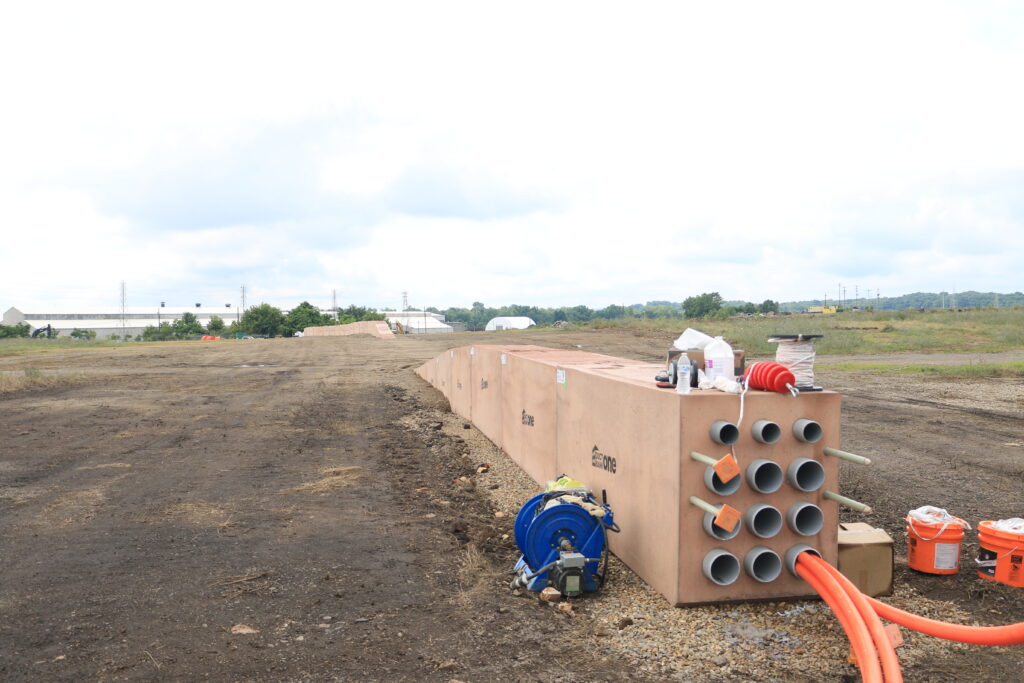
Precast changes the exposure math, not the safety program. A five-person crew digs, sets, and backfills in a single shift. One worker inside the shield. Sections align mechanically. The trench closes at end of shift instead of end of week.
Below are the questions GCs and safety managers actually ask us in prequalification, answered directly.
Cast-in-Place vs. Precast: The Exposure Numbers
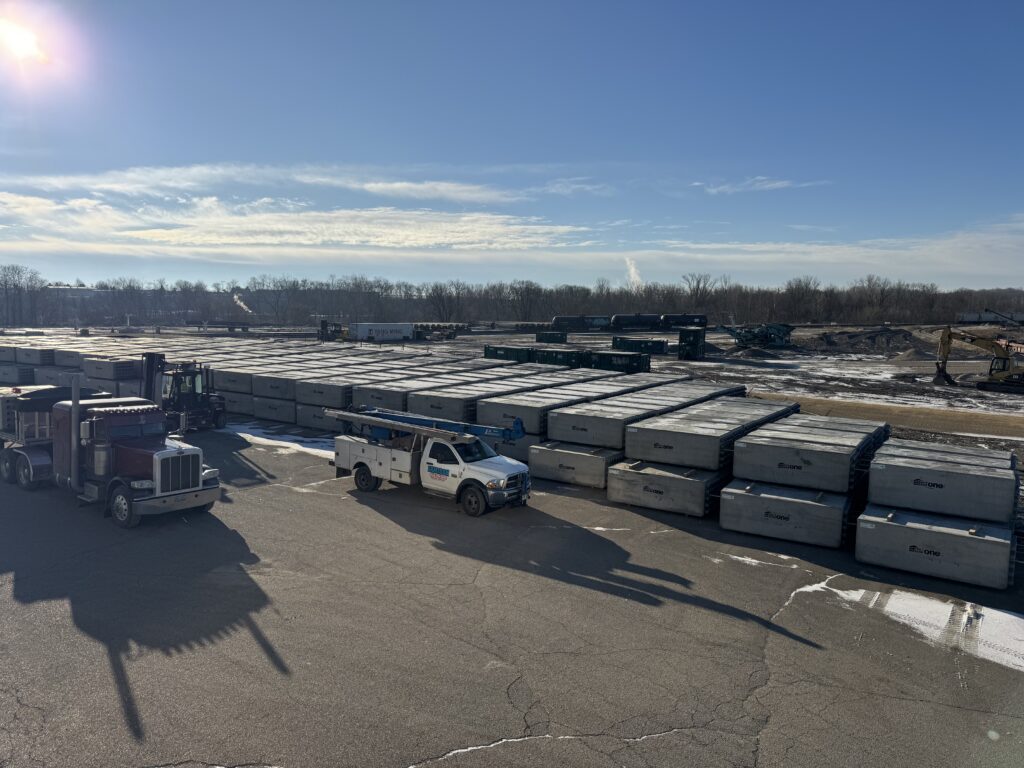
Both runs below are from the same hyperscale data center site in Hamlet, North Carolina.
| Cast-in-Place | DBO Precast | |
|---|---|---|
| Workers in the trench | 10–15 | 1 |
| Total crew | 12 | 5 |
| Open trench at any time | 400 LF | 20–24 LF (one shield) |
| Open trench duration | 6 days | 1 shift |
| Trench boxes on site | 19 | 1 |
| Section alignment | Hand-guided, pry bars, spotters | Mechanical, guided dowel pins |
| Backfill | After cure | Same day |
| Production | 400 LF in 6 days | 320 LF in 1 day |
Same site, same scope, same soil — roughly a tenth of the people below grade for a sixth of the time.
How does precast reduce worker hours inside the trench?
Cast-in-place puts 10–15 people in the trench for the full cycle: conduit assembly, rebar, formwork, pour, cure, backfill. Precast puts one, and only to hook and unhook rigging.
The Hamlet comparison above is the clearest version we have. Twelve workers over six days to place 400 feet became a five-person crew placing 320 feet in a single day — and that figure doesn’t include the weather delays, concrete delays, or inspection holds the cast-in-place run absorbed.
Can sections be installed without workers entering the trench?
Placement, alignment, and joining all happen from the surface. No one enters the trench to guide a section into position.
One crew member works inside the shield to hook and unhook the rigging, and that person stands on top of the set duct bank — not on the trench floor. If a shield shifts, it bears on the precast section. That positioning is a safety feature of the product, not a procedure we ask crews to remember.
Can sections be guided mechanically rather than manually?
Yes. Every section carries a guided dowel-pin and shear-key joint. The operator lands the piece within 18 inches of grade and the pins pull the joint into alignment — including conduit continuity through the joint.
No hand alignment. No pry bars. No spotter reaching between two sections to line up pipe.
How are workers protected during alignment and joining?
This is the mechanism that matters most on this page. The dowel pins engage while the sections are still 18 inches apart. Once they catch, the installer steps clear and the pins do the closing.
On hand-aligned systems, a worker’s hands are on the section at roughly four inches of gap while thousands of pounds of concrete close on the joint. That’s the pinch point every trench safety program tries to manage with training and toolbox talks. We designed it out instead.
What is the rigging procedure for each section?
Four-point pick using the cast-in lifting anchors, four-leg chain bridle, hooked and unhooked at grade or from the top of the set section.
DBO recommends and supplies four-way chains with self-closing safety latches, provided on request — we run them on roughly half of active jobsites. We don’t recommend spring-latch hooks; the springs fail with use, and a latch that fails open on a suspended section is not a risk worth taking.
Are engineered lifting points built into every section?
Yes. Four cast-in lifting anchors per section, engineered so any two carry the full load, at a 4:1 safety factor. Section weights are issued with the submittal package so your crew can verify capacity against their rigging and their machine chart.
Do you provide engineered lift plans?
Yes. A lifting plan ships with every submittal package. Every job, no exceptions — not a document you request after award.
What equipment capacity do you require?
No dedicated crane, and no upsizing the machine you already have. DBO sizes each section to the excavator digging the trench.
We provide section weights during design. If a configuration exceeds what your machine can safely handle, we split it into smaller sections. The equipment that opens the trench sets the duct bank and backfills behind it.
What trench width and working clearances are required?
Two inches of clearance on each side between the section and the trench box or sidewall is what we recommend — enough buffer to set cleanly without oversizing the excavation.
No one works between the precast and the sidewall at any point in the sequence.
What precautions do you recommend around open excavations?
Trench protection, shoring design, and fall protection stay where they belong: with your competent person, under OSHA 1926 Subpart P. We don’t design your protective system and we won’t pretend to.
What precast changes is how much of it you’re exposed to. One shield length open for one shift instead of 400 feet of open edge sitting through six days, three shift changes, and a weekend.
What ground conditions are required to set sections safely?
DBO takes full structural responsibility for the duct bank system and issues the required PSF bearing pressure with the submittal. Meeting it on site is the contractor’s scope.
In practice, about 99% of installs set directly on native subgrade — no gravel subbase required.
High water table isn’t a stopper either. Bed of gravel to keep boots dry, sump pump in the shield, and you dewater one trench length at a time instead of a 400-foot run. One recent run went 19.5 feet deep with the water table at 15 feet and still hit 320 LF/day with a five-person crew.
Do you provide safety and installation training before the first placement?
Yes, two ways. On-site training ahead of the first placement, or hands-on training at our Canton Training Facility — a live trench environment with real soil and a working excavator, not a shop floor and a slide deck.
Will a manufacturer representative be onsite for the first installation?
Yes. A DBO rep is on site for the first one to two days of every first install — recent examples include Baton Rouge, Louisiana and Warrenton, Missouri. Most crews are running independently by day three.
Can you provide JHA/JSA, installation manuals, rigging procedures, and SDS documentation?
Yes — all four, available during prequalification or after award. Ask your DBO contact and we’ll send the package.
What happens if a section is damaged on site?
Damaged sections go back to the plant on the return flatbed. We don’t field-repair — at the rate crews set sections, replacement is faster and cheaper than a repair procedure in the trench.
It comes up rarely. Damage rate to date runs under 0.5%. On the Hamlet job — 3,900 pieces — two were damaged, both from equipment contact on site.
Why does DBO hold product until full design strength?
Because lifting anchors pull out of green concrete. It’s a known failure mode in this industry, it has shut down active jobsites, and it happens when a plant ships to hit a delivery date before the piece is ready.
No DBO product leaves the yard until it meets full design strength — which is also why sections can be set and driven over the same day they arrive. Our casting capacity means product is finished weeks ahead of your trench, so there’s never a reason to rush a piece out the gate.
Fewer people below grade. Fewer hours of open trench. Fewer decisions left to a spotter with his hands in a closing joint.
That’s how we build.
Have a safety prequal package to fill out? Send it to our engineering team — we’ll return it with lift plans, bearing pressure requirements, and installation documentation attached.