
If Your Duct Bank Is Waiting on a Concrete Truck, You Already Know the Problem
You scheduled the pour for 8 a.m. Foundations were supposed to go at 4, but weather and callouts pushed them to 6. That pushed your duct bank pour to 1 p.m. — and five crews of six stood around for five hours doing nothing.
Nobody on your team did anything wrong. The batch plant was overwhelmed. Every trade on the site — foundations, spread footers, building pads, duct banks — was pulling from the same strained supply, and duct banks sit at the bottom of that priority list every time.
When the local concrete supply gets squeezed, cast-in-place duct banks are the first scope to slip and the last to recover.
That’s happening right now on data center and industrial builds across multiple regions. Wherever a big job is drawing down local ready mix capacity, the duct bank scope is sitting in the queue. And the usual recovery move — doubling the crew to push a higher install rate — doesn’t solve it. The crew is ready. The concrete isn’t.
The Cost Isn’t the Trucks. It’s What the Trucks Block.
A half-day slip on a duct bank pour doesn’t just affect that one trench. Idle labor bills regardless of whether concrete shows up. Open trench hours stretch into open trench days. ECs get pulled off other work to sit on standby. Grading, paving, switchgear, and energization all push back a day at a time.
On a hyperscale campus, a one-week slip on a duct bank corridor can cost $1M or more per month in lost energization uptime. That number doesn’t appear on any bid sheet — it’s the one the owner is tracking.
The Flowable Fill Trap Most GCs Don’t See Coming
Here’s the part that catches people off guard: flowable fill comes from the same ready mix plant. Same trucks. Same queue.
So even when you think you’ve solved the duct bank pour, you still need flowable fill to backfill it — and that’s another trip to the same strained vendor. On medium and high voltage runs where flowable fill is specified for thermal performance, you’ve effectively doubled your exposure to the same bottleneck.
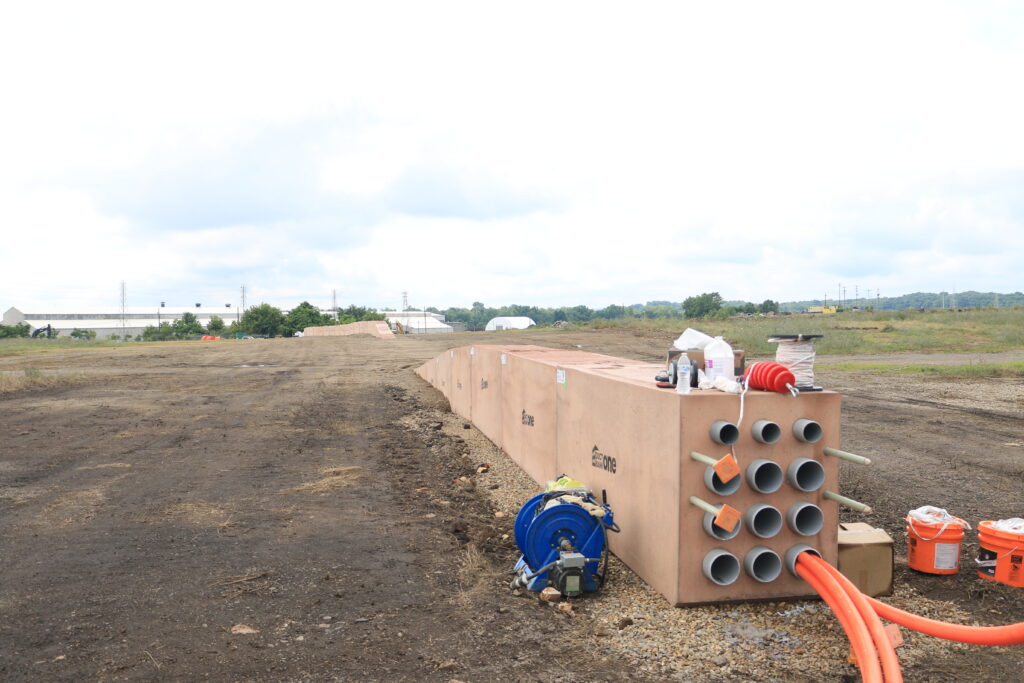
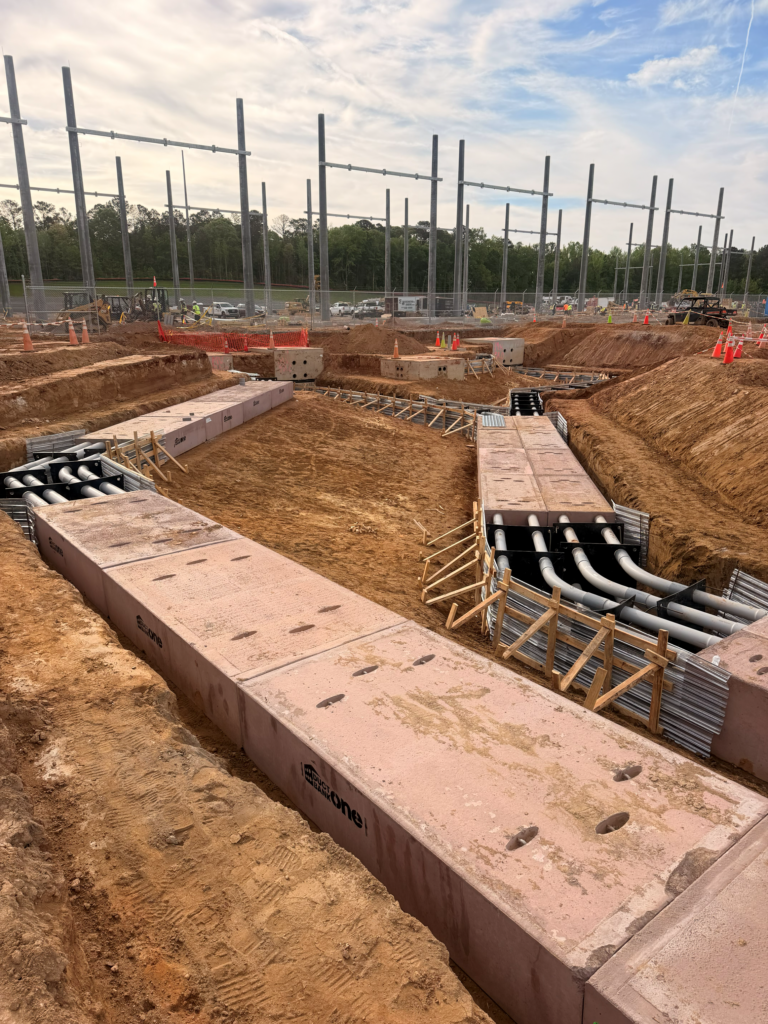
DBO’s precast sections typically eliminate the flowable fill scope entirely. We extend the concrete envelope above the conduit bank in the precast itself, and our mix design runs a significantly lower thermal resistivity (ρ) value than standard flowable fill — which means cables can carry more power through the run, not less. One contractor told us after three jobs in a row they’re done specifying flowable fill. It’s one more scope they don’t have to chase a truck for.
Why Precast Doesn’t Share Your Supply Chain
DBO pulls cement from a direct terminal relationship, aggregate from a quarry adjacent to our plant, and inbound bulk materials via rail. When a data center build strains the local batch plant in Charlotte, or Phoenix, or Columbus, it doesn’t affect our production — we’re drawing from a different supply chain entirely, and our output ships finished, not in a drum.
That’s the structural difference. When your trench is cut, the sections are already cured, tagged, and staged. No truck slot required. No batch plant conflict. No weather window to chase. The material risk moves off your critical path and onto ours.
| Scope Item | Cast-in-Place | With DBO Precast |
|---|---|---|
| Ready mix trucks | 4–8 loads per run | Zero — sections arrive finished |
| Flowable fill trucks | 2–4 additional loads per run | Typically eliminated |
| Batch plant coordination | Competes with foundations/pads | None required |
| Crew standby on slipped pours | 5–10 crew-hours | Dig, set, backfill in one shift |
Field Example — Regional Data Center Build (Southeast)
A GC working a major data center campus ran into exactly this pattern. Local ready mix capacity was stretched across multiple primes on the same site. Even with an on-site batch plant, duct bank pours kept getting bumped for foundations and pads.
Their first move was the typical one: double the install crew to push a higher cast-in-place rate. It didn’t work — the crew was ready, the concrete wasn’t. Converting the remaining runs to precast took the duct bank scope out of the queue entirely. Same excavator, same trench prep, but sections came off the truck cured and ready. Trenches closed the same day they opened, with a fraction of the crew, and the duct bank stopped competing with foundations for 4 a.m. pour slots.
When Precast Is the Right Call
Not every run needs it. It’s the answer when:
- The site is drawing down local ready mix capacity
- Flowable fill is specified, and the thermal requirement can be met with precast geometry
- The duct bank sits on the critical path to an energization or turnover date
- Crew standby is already eating into margin on slipped pours
If three or more of those apply — on your current job or the next one — precast pays for itself before the first truck would have shown up.
If the Concrete’s Late, Everything’s Late
Cast-in-place duct banks work when the local supply chain has headroom. On today’s data center and industrial builds, it doesn’t.
If your concrete is late, your duct bank is late. If your duct bank is late, your energization is late. Precast breaks that chain.
Typical lead time on a confirmed order runs 4–6 weeks. Stamped calcs come back in 10–14 days. If you’re in the pinch now or scoping a project that’s going to land in one, talk to engineering before your GC is fighting for a 4 a.m. pour slot.
That’s how we build.