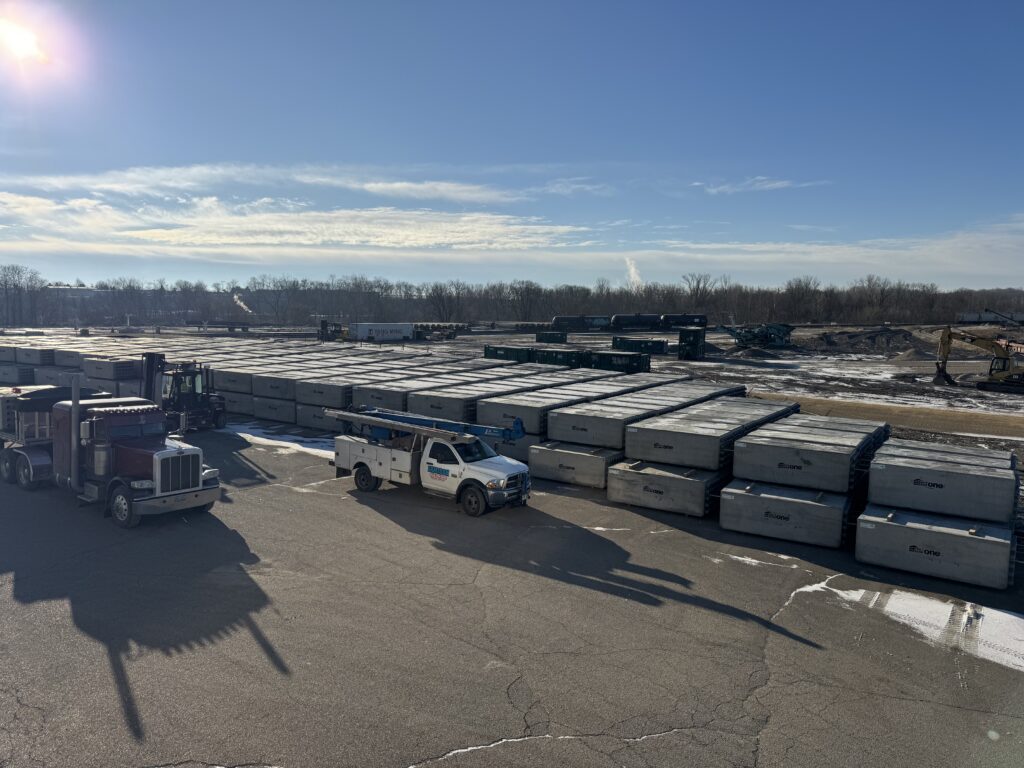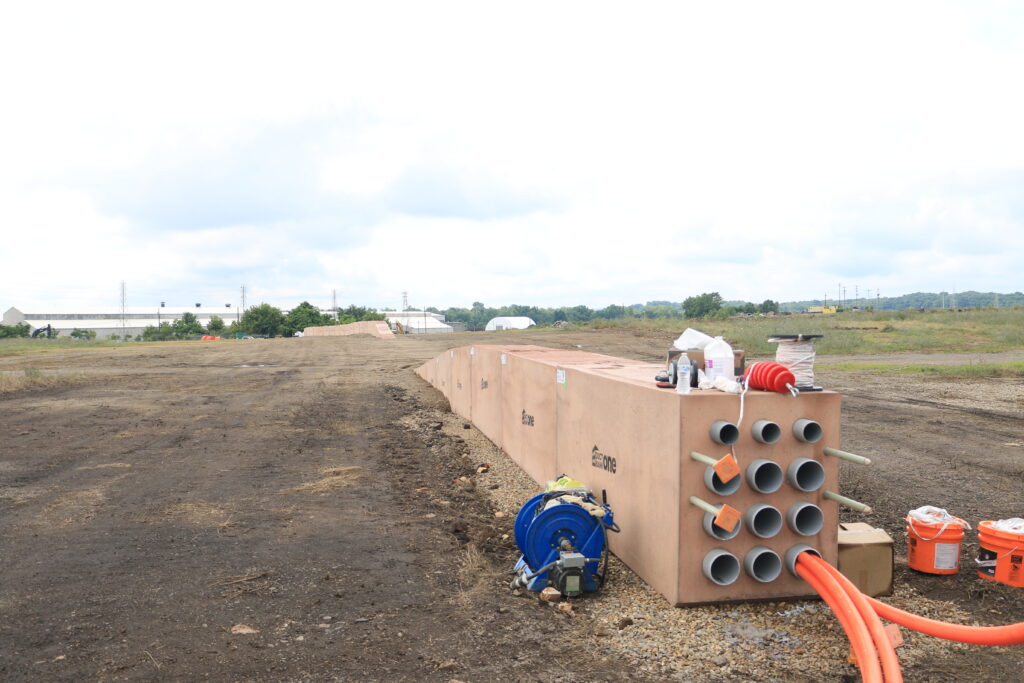

Three products get pitched for the same scope — cast-in-place, utility trench systems, and precast duct bank and they get pitched as if they’re interchangeable. They aren’t. Pick the wrong one and you either lose the schedule or lose access to your cable.
How to choose
Go cast-in-place if: the run is congested and heavily customized, as-builts are unreliable and conflicts get resolved in the hole, bends are tight and constant, access for equipment is limited but the run is short
Go utility trench if: you can’t get an excavator to the work, the site is live and confined, crews need frequent cable access, loading is light-duty, install speed isn’t driving the schedule
Go precast if: the run is long or repeating, the duct bank sits on the critical path to energization, the site is secured and cable access should be restricted, loading is traffic, rail, crane, or aircraft, you already have an excavator on site, the trench needs to close the day it opens
Every one of these has a job it does better than the other two. Here’s the comparison, then the reasoning.
| Cast-in-Place | Utility Trench System | Precast Duct Bank | |
|---|---|---|---|
| Install rate | 20–30 LF/day | ~140 LF/day on campus programs | 100–200 LF/day |
| Crew to install | 10–15 | 8–10 | 1 |
| Open-trench duration | 3–6 days per run | Multi-day, at grade | Under one shift |
| Equipment required | Excavator, trucks, pumps | Minimal — hand-set | Same excavator that digs |
| Cure wait before backfill | 7+ days | None | None — backfill same day |
| Grade / directional deviation | Field-adjustable | Near zero — follows grade | 4 ft over 50 ft; 8% up, down, side to side |
| Load ceiling | Design-dependent | Light traffic duty | Traffic, rail, crane mat, aircraft |
| Cable access after install | Excavate | Lift a lid | Pull through conduit |
| Relative cost | Lowest material, highest labor | Highest material | Highest material, lowest labor |
When cast-in-place is the right call
Cast-in-place wins where the run can’t be drawn before you dig it.
Downtown roadways, sidewalks, and congested corridors where existing utilities snake over and under each other — spaghetti noodles, tight bends, and a hundred years of infrastructure that never made it onto an as-built. You hydrovac, you find something nobody knew was there, and you adjust the run in the hole.
Prefab can’t price a decision you’re making on the fly. No manufacturer can cast a section for a conflict that gets discovered at 10 a.m. on a Tuesday. In that environment, cast-in-place isn’t the fallback — it’s the correct method.
When a utility trench system is the right call
Trench systems win where equipment can’t reach and crews need the cable back.
Live substations are the clearest case. You are not putting an excavator between energized gear and structural steel to set a section. Crews physically carry fiberglass trench into position and hand-set it. Same story on constrained industrial sites with no access lane.
The second case is inspection. If the operating plan calls for getting to that cable regularly, a removable lid beats excavating.
Be clear-eyed on the tradeoffs:
- Premium material cost — these are the most expensive product of the three
- Subbase has to be near-perfect and flat; most runs need drainage underneath, because they don’t float like a bathtub
- Lids and joints have to line up tight, which slows the install
- Sits at grade and follows grade, so getting above or below an existing utility is difficult
- Load ratings typically max out in light traffic duty
We’re not talking around this product. DBO has bought thousands of feet of utility trench to complement precast on data center work — because on those runs, it was the right call.
When precast duct bank is the right call
Precast wins on volume, speed, load, and security.
Sections arrive cured. There’s no pour window, no cure hold, and no waiting to release the trench. Dig in the morning, set by midday, backfill by afternoon — and heavy equipment crosses that run 20 to 30 minutes later. Nothing about that sequence depends on the weather or the batch plant.
The equipment argument matters more than most people expect: you already have an excavator on site to dig the trench. The machine that digs it sets it. No crane mobilization, no additional lifecycle cost, no second piece of iron.
Precast also carries loads the other two can’t. Traffic, rail, crane mat, military, aircraft — the reinforcement and joint geometry get designed to the condition, not pulled from a catalog.
And on secured sites, there’s an argument that doesn’t show up on a bid sheet. An open trench system running through a data center campus is a row of removable lids sitting over medium-voltage and fiber. Precast is enclosed conduit — there’s nothing to lift. Behind a monitored substation fence, lids are a non-issue. In the middle of an active campus, that’s a different conversation.
One thing to verify with any precast supplier: when demand outruns plant capacity, sections can ship before they reach design strength — and green concrete doesn’t hold a lifting anchor. DBO releases nothing below full design strength for same-day install. At 320 sections per day across four curing lines, product is finished weeks ahead of the delivery date. Ask what the release criteria are before you sign.
Field Example — Hyperscale Campus (Southeast)
A 400-foot cast-in-place run on a hyperscale campus, measured across the full cycle — dig, set trench box, install conduit, pour, cure, pull boxes, backfill.
| Cast-in-Place | DBO Precast | |
|---|---|---|
| Trench boxes | 19, staged in a row | 1 |
| Open trench | 400 ft for 6 days | 24 ft for one day |
| Crew | 12 | 5 |
| Full cycle | 6 days | Same day — 320 ft set and backfilled |
The pushback we get on that six-day number is always the same: it only takes me two days to build and pour a duct bank. Sure — but that’s the duct bank, not the cycle. We’re counting from the first bucket of dirt to a closed trench.
Two more things that number doesn’t include: weather delays and late concrete. Add either one and the gap widens.
Then there’s the trench box spread itself. Nineteen 24-foot boxes rented across a run isn’t a rounding error — directionally, that’s a five-figure monthly line item most estimates bury in general conditions.
The safety difference nobody writes about
Headcount is the obvious one: one worker in the trench instead of ten.
The mechanism is the part that gets missed. On a precast install, the one person down there is standing on top of the duct bank. If the trench box shifts, it pins against the precast — it can’t reach him. That’s a structural condition, not a procedure.
Compare that to a cast-in-place trench with ten-plus workers at the bottom, gluing conduit and tying steel around wet concrete and equipment traffic. Same run, same scope, a fraction of the exposure.
Pick the product that fits the job
Use cast-in-place where runs are congested, heavily customized, or crossing utilities nobody can locate on the as-builts. Use a utility trench system where equipment can’t reach and crews need frequent hands-on cable access. Use precast where you need volume, speed, load rating, and a closed trench by end of shift.
There’s a time and a place for all three. Most of the industry sells one and calls the other two obsolete — that’s not how the field works.
What’s changed is that on high-volume, schedule-driven programs, the labor and time gap isn’t close. Half the manpower and a fifth of the schedule at comparable linear footage. When the run supports it, precast isn’t the alternative — it’s the baseline.
Typical DBO lead time runs 4–6 weeks, with stamped calcs back in 10–14 days. If you’re scoping a run and you’re not sure which method fits, talk to engineering before it’s in a bid.
That’s how we build.