
For decades, the conduit in a duct bank was an easy call. Schedule 40 PVC, every time.
On medium-voltage power runs — industrial plants, substations, utility programs, data center campuses — there’s now a real choice to make. Most new specs call for cable rated to run at 105°C, and fiberglass conduit is the way to use that cable at everything it’s rated for.
The right answer depends on what your job needs. Both conduits belong in the ground. The goal is getting full value out of what you’re already buying.
Fiberglass conduit is rated to 110°C. PVC is rated to 90°C in a concrete duct bank. Code doesn’t allow cable to run hotter than its conduit. So if your design uses 105°C cable, fiberglass is how you get its full capacity. PVC still handles duct banks with room in their heat margin, at lower material cost.
| Schedule 40 PVC | Fiberglass (RTRC) | |
|---|---|---|
| Temperature rating in a duct bank | 90°C | 110°C |
| Runs 105°C cable at full capacity? | No | Yes |
| Material cost | Lower | Higher, and narrowing |
| Weight | Heavier | Much lighter |
| Pull friction | Higher | Lower |
| Lead time | Typically in stock | 8–10 weeks |
Why does the conduit’s temperature rating matter?
Because the conduit sets how much power the cable is allowed to carry.
Cable heats up as current flows through it. The hotter a cable is allowed to run, the more current it can carry. That limit is called ampacity — the maximum current a cable can safely carry.
Most new medium-voltage cable is MV-105, rated to run at 105°C. But the National Electrical Code (NEC 352.10) says cable in PVC conduit can’t run hotter than the PVC’s rating. In a concrete duct bank, that’s 90°C.
So MV-105 cable in PVC gets designed like 90°C cable. You bought 105°C cable and used it at 90°C.
That 15°C difference adds up on any dense duct bank. Conduits sit close together and heat each other. Engineers often run out of heat margin before they run out of conduit space.
Fiberglass conduit (RTRC in the code) is rated to 110°C, so the cable can run at its full 105°C rating. That can mean fewer cable runs, a smaller cable size, or room for future load.
One check first: the cable ends land on equipment that’s often rated for 90°C. Confirm how your design handles that so the gain shows up where you need it.
Which conduit fits your job?
PVC is the efficient choice when:
- Your heat calcs pass with margin to spare
- Cable is rated 90°C
- Conduit is needed on short notice
- Material budget is the tighter constraint
Fiberglass earns its cost when:
- You’re specifying MV-105 cable and want its full ampacity
- Duct banks are dense, stacked, or running near their heat limit
- Future load growth is likely
- Long pulls between vaults make lower friction valuable
Every job has its own needs. We build to both.
Who makes the call?
Whoever runs the heat calculations. Usually that’s the electrical engineer of record. On design-build work, it’s more and more often the electrical contractor.
Schedules on large power and industrial programs move fast, and the electrical design often isn’t finished when the job goes to bid. That pushes the duct bank design onto the contractor.
When you design before the cable is locked in, extra heat margin works like insurance.
What does fiberglass cost?
Fiberglass carries a material premium over PVC, and the gap has been narrowing as capacity comes online. Conduit size, wall thickness, and market supply all move the number.
The premium comes from how it’s made. PVC is pushed out in one continuous process. Fiberglass is wound in layers around a form, soaked in resin, and cured.
Fiberglass is much lighter, so on field-built duct banks it installs faster and recovers part of that premium in labor.
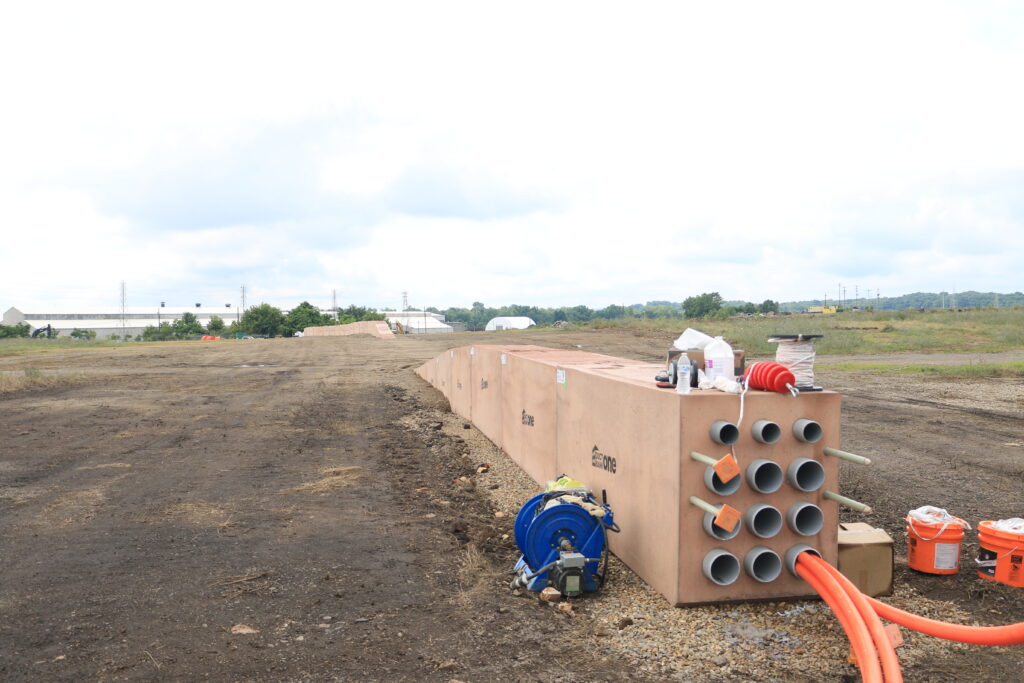
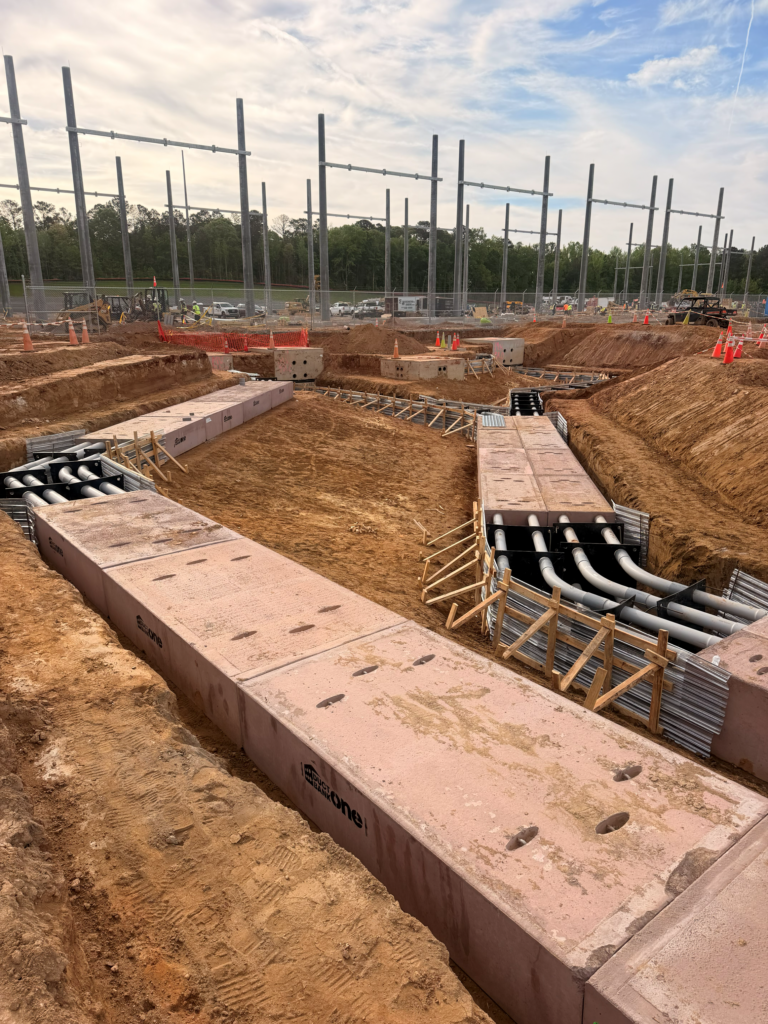
Precast changes that math in a way worth knowing. DBO places conduit in steel fixtures at our plant, not in your trench, so the install labor is already out of your scope either way. Compare material cost against what the higher rating buys you in cable capacity.
Put simply: if you’re buying 105°C cable, fiberglass is what lets you use all of it.
What else changes with fiberglass?
- Easier cable pulls. Lower friction means cable pulls through long runs and bends with less force.
- Different inside diameter. Run your conduit fill calcs on fiberglass’s own dimensions (NEC Chapter 9, Table 4), not PVC numbers.
- Protection from impact. Fiberglass can crack if struck hard. In precast, it’s encased in concrete before it leaves our plant.
Does fiberglass help heat escape the duct bank?
Fiberglass handles more heat. The concrete and soil carry that heat away. Both parts have to work.
Heat moves from the cable, through the conduit, into the concrete, and out into the soil. A high-rated conduit in poor concrete just moves the limit somewhere else.
That’s why DBO’s concrete targets low thermal resistivity — a measure of how much a material resists heat flow. Our mix stays below 55 °C-cm/W at 5,000 psi or stronger, whichever conduit is inside.
Is DBO ready to cast fiberglass?
Yes. We’ve already cast fiberglass conduit in sections at our plant. We build duct banks with fiberglass from 2-inch through 12-inch, matching what the conduit suppliers produce. Steel fixtures hold the same spacing whichever conduit goes in.
How long does fiberglass conduit take to get?
Supply has caught up with demand. Our suppliers now quote fiberglass in the 8–10 week range, and we have a supply partner adding capacity as demand grows across data center, industrial, and utility work.
If your project already has a preferred fiberglass supplier, we’ll work with them.
Our precast sections typically ship 4–6 weeks after a confirmed order, with stamped calcs in 10–14 days. Decide on conduit at design approval so it’s ordered alongside your calcs, not after.
Spec the Conduit Your Heat Calcs Call For
Fiberglass opens up capacity that PVC leaves on the table when you’re running 105°C cable. PVC does the job efficiently when the heat margin is there.
Tell us what the job needs. We’re ready to cast either one.
Weighing fiberglass for your next duct bank? Talk to DBO engineering before your conduit spec is final. We’ll compare temperature ratings, sizing, lead time, and cost for your run.