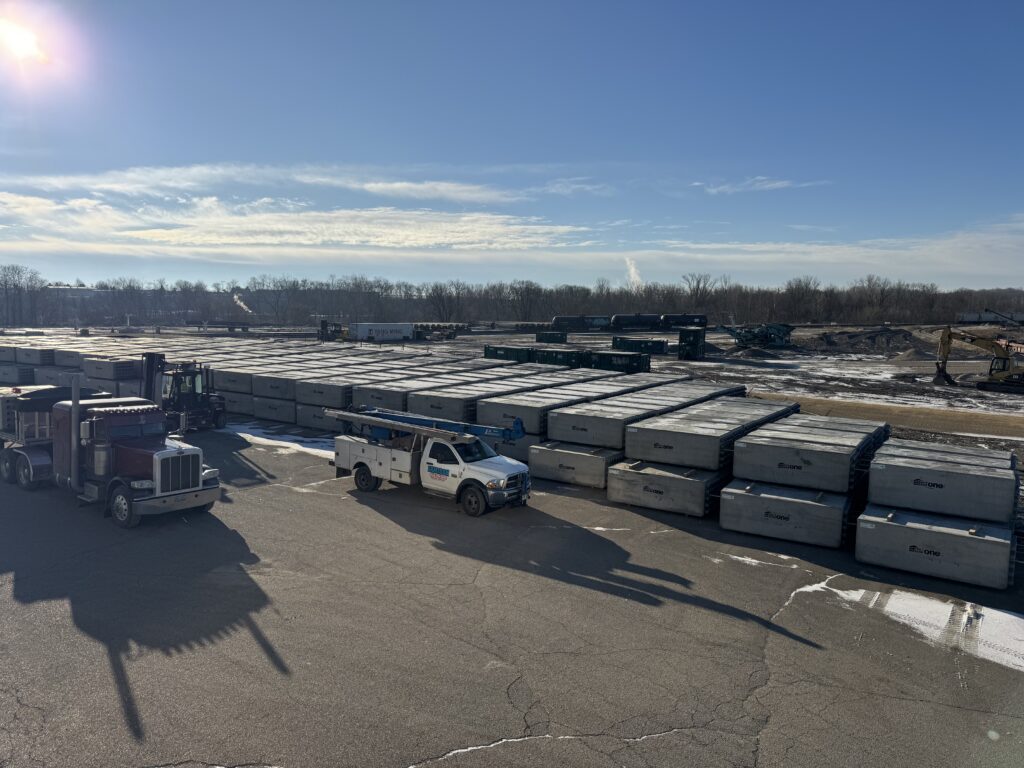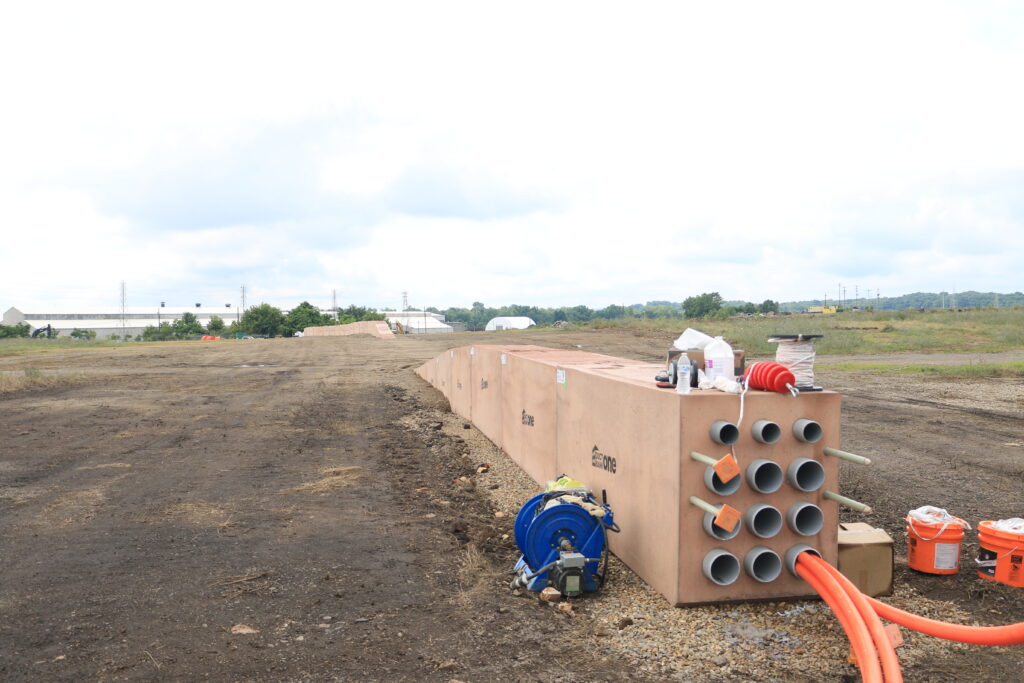

You put a pre-cast number next to the cast-in-place number and it looks expensive. Every bid package in this industry compares material to material — conduit and concrete on one line, everything else somewhere else. That comparison is about a third of the job.
On an all-in installed basis, precast lands in the same cost band as cast-in-place. The difference is how the number is built. Precast carries more on the material line because freight is real. It carries far less on labor, excavation, standby, and the days your trench sits open. If you’re cross-shopping precast manufacturers, the ranges below give you a starting point. What separates suppliers inside those ranges is capacity, lead time, and whether anyone shows up for your first install.
What Does a Duct Bank Cost Per Linear Foot?
One thing that decides whether these numbers help you or mislead you.
A duct bank has four cost buckets, not one:
- Material — conduit, concrete, steel, delivered
- Excavation — the crew, the machine, and how long it’s tied up
- Installation labor — how many people, for how many days
- Trench days — what the open hole costs everything behind it
Most bid forms only ask for the first one. That’s the whole problem. Price bucket one and you’ll pick the wrong method about half the time, because buckets two through four are where the money actually moves.
The table below is all-in installed — material, excavation, and installation together. These are industry cast-in-place estimates, and precast falls inside the same bands.
| Way Count | 2″ PVC | 3″ PVC | 4″ PVC | 5″ PVC | 6″ PVC | 8″ PVC |
|---|---|---|---|---|---|---|
| 2-way | $175–230 | $205–255 | $230–285 | $255–330 | $290–380 | $370–445 |
| 4-way | $180–235 | $205–260 | $230–295 | $260–335 | $300–390 | $360–460 |
| 6-way | $225–290 | $255–330 | $290–375 | $330–425 | $380–490 | $455–585 |
| 8-way | $275–355 | $315–405 | $355–460 | $405–525 | $465–600 | $560–720 |
| 10-way | $335–430 | $380–490 | $430–555 | $490–635 | $565–730 | $680–875 |
| 12-way | $390–505 | $445–575 | $505–650 | $575–740 | $660–850 | $790–1,020 |
| 14-way | $455–585 | $515–665 | $585–755 | $665–860 | $760–980 | $915–1,180 |
| 16-way | $525–675 | $595–765 | $675–870 | $765–990 | $875–1,130 | $1,050–1,350 |
Above 16-way and especially on the 30-way and stacked configurations going into data center work — pricing is quoted per project, because geometry and stacking drive it more than any table can.
What Drives the Spread?
Four things move you inside a band, and the first one is the biggest:
- Excavation depth and soil. This is the dominant variable — depth of excavation, soil type, water table depth, and backfill requirements move the number more than anything else on this page. A bank at 3 feet in good soil and one at 20 feet with a double-stacked trench box, a water table, and haul-off are not the same job. Budget roughly $200/LF all-in for excavation on good soils at about 6 feet, and go up from there.
- Conduit count and size. More conduits means more section, more steel, more weight. A 4-inch bank and a 2-inch bank at the same way count are different products — you can read that straight across the table above.
- Rebar schedule. Set by what rolls over the top — highway, crane mat, rail, aircraft.
- Thermal mix. Where the spec calls for a low resistivity (ρ) value to protect cable ampacity, mix design costs more per yard. It also frequently deletes your flowable fill scope, which cuts the other direction.
Where’s the Breakeven?
Two variables decide it: run length and conduit count.
- Under 500 LF — usually doesn’t pencil. Your crew burns the run getting up to speed and never gets the reps back.
- Over 500 LF — slam dunk. That’s the line we hold to.
- Under 10-way — breakeven to modest savings. At 4-way and below, you need volume.
- Over 10-way — different category entirely. At 120-way there is no cast-in-place answer. There isn’t enough labor available to hand-tie that in a trench on a data center schedule.
One caveat: we ship 2-way to a contractor running over 100,000 LF of it. Five-man crew, 300–400 feet a day, and he’s making better margin than he’s made on any cast-in-place run in his career. Low way count plus high volume plus expensive labor beats the rule of thumb every time.
That’s why your labor market matters as much as your configuration. Remote campuses with no local hall to pull from run on flown-in crews, per diem, and housing — several times a normal labor rate. Cutting a crew from twelve to five is worth a lot more there than it is in a metro with deep labor.
Same Total, Different Composition
Here’s the part that answers the question we get most: why is precast more expensive? On the material line, it is. Freight is the delta — we have to put a finished, cured product on a truck and get it to your site. There’s no way around that and we won’t pretend otherwise.
Here’s the part that gets lost: material is roughly a third of the installed number. Excavation alone runs about $200/LF on good soils. So a premium on the material line moves the total by a fraction of what it looks like on a spec sheet and it moves it in the one bucket that doesn’t compound. Labor, standby, and trench days all compound. Material doesn’t.
| Cost Bucket | Cast-in-Place | Precast |
|---|---|---|
| Material, delivered | Baseline | Higher — freight is the delta |
| Field crew | 10–15 | 5 |
| Excavation | Separate crew, separate mobilization | Same crew — the excavator sets the sections |
| Equipment standby | Machine idles days waiting on the trench | None |
| Flowable fill | 2–4 additional truckloads per run | Typically eliminated |
| Cure hold before backfill | 7+ days | None |
| Trench open, per run | 3–6 days | Same day |
The excavation line is the one estimators miss. On a cast-in-place bid, the excavation crew digs and then the machine sits — a week, two weeks — while the electrical crew works the trench, pours, and waits on cure. On precast, the excavator is the install equipment. One mobilization instead of two, and the machine never waits.
Fewer moving parts is the whole argument. No batch plant slot to chase. No pour window to hit. No cure hold. No flowable fill trip behind it. Every scope you delete is a scope that can’t slip and every day the trench closes early is a day the trades behind you get back.
Run the Math on 1,000 Feet
Take an 8-way, 4″ PVC run — a common data center configuration. Off the table, all-in installed lands somewhere around $355,000 to $460,000. Both methods get there. They just get there differently.
| Bucket | Cast-in-Place | Precast | Who’s ahead |
|---|---|---|---|
| Material, delivered | Baseline | Higher — freight is the delta | CIP |
| Excavation | Separate crew, machine tied up ~15 days | Same crew sets the sections, ~3 days | Precast |
| Install labor | 12 workers × 15 days = 180 crew-days | 5 workers × 3 days = 15 crew-days | Precast, badly |
| Flowable fill | 2–4 loads per run | Typically none | Precast |
| Trench days | ~15 | ~3 | Not on the bid sheet at all |
The material premium is real. It’s also the only line where you’re behind and it’s covering 165 crew-days on the other side. Whatever your loaded crew rate is, multiply it by 165. That’s the number sitting opposite the material line. On most jobs it more than covers the premium.
Field Example — Hyperscale Data Center Campus
Same site, same scope, both methods.
- Cast-in-place: 19 trench boxes staged end to end, 12 workers, six days to run 400 feet. That’s the honest full cycle — dig, set boxes, install conduit, pour, cure, pull boxes, backfill. Not “two days to build it and pour it.”
- Precast: one trench box, five workers, 320 feet set and backfilled in a single day.
Half the manpower and a fifth of the schedule and that comparison assumes zero weather delays and zero late concrete trucks.
What’s in Our Number and What’s Not
Our quote is a delivered, engineered, supported number. It is not an installed number.
- Included: sections engineered to your conduit layout, cover depth, and load case · freight to the jobsite · stamped structural calculations in 10–14 days · full submittal package with lifting plan · crew training · on-site support for your first install.
- Not included: excavation, shoring, trench boxes, dewatering · bedding, backfill, compaction · installation labor and equipment · permits, traffic control, restoration.
- We size every section to the excavator already digging your trench — no crane mobilization, no upsized equipment, no line item you didn’t plan for.
What Moves the Price Up or Down?
| Factor | Direction | Why |
|---|---|---|
| Depth and soil conditions | ↑ | The single biggest driver of installed cost, on either method |
| Load rating (rail, aircraft, crane mat) | ↑ | More steel, tighter deflection limits, full-scale verification |
| Thermal mix requirement | ↑ product, ↓ scope | Costs more per yard, frequently deletes flowable fill |
| Freight distance | ↑ | The largest single input to the material premium |
| Run length and repeat volume | ↓ | Repeated geometry is what a dedicated form line is built for |
| Delivery sequencing | ↓ | Staging full phases beats daily drops if you have the yard space |
| Corner bends and vault tie-ins | Neutral to ↓ | Precast-in, precast-out with a small closure pour absorbs field tolerance stack |
| Multi-phase program | ↓ | We cure and stage ahead of your trench instead of chasing a production slot |
Site access usually runs in your favor. Precast deviates roughly 4 feet over 50 feet of lay length and adjusts about 3 inches per 10-foot section vertically. That’s how a run threads between existing utilities without an RFI cycle and a redesign.
How Firm Is a Quoted Price?
- What locks it: an approved design and released submittal. Once conduit layout, cover depth, load case, and section geometry are approved, the sections we cast are the sections we quoted. We don’t ship product until it hits full design strength — no curing in transit, no green tops on your jobsite.
- What can change it: a scope change. Added ways, a revised load rating, a route change that adds bends or vault tie-ins, a depth change that redraws the reinforcement schedule. Tell us early. Repricing at submittal costs nothing. Repricing after we’ve cast costs schedule.
Get the Full-Scope Number Before You Bid
If you’re comparing us line-to-line against a cast-in-place take-off, you’re comparing about a third of the job. Put labor, excavation, standby, trench box rental, flowable fill, and the cure hold in the same column. That’s the number that decides your margin. Want to run your own numbers first? Start with the takeoff, then send us your run length, way count, conduit size, cover depth, and load case. We’ll give you a real range in a day, stamped calcs in 10–14 days, and product in 4–6 weeks.